Goal Battle - PvP Soccer Game
- 4.5
- Rating
- 5.00M
- Installs
- Free
- Price

 Analysis by App-foxy
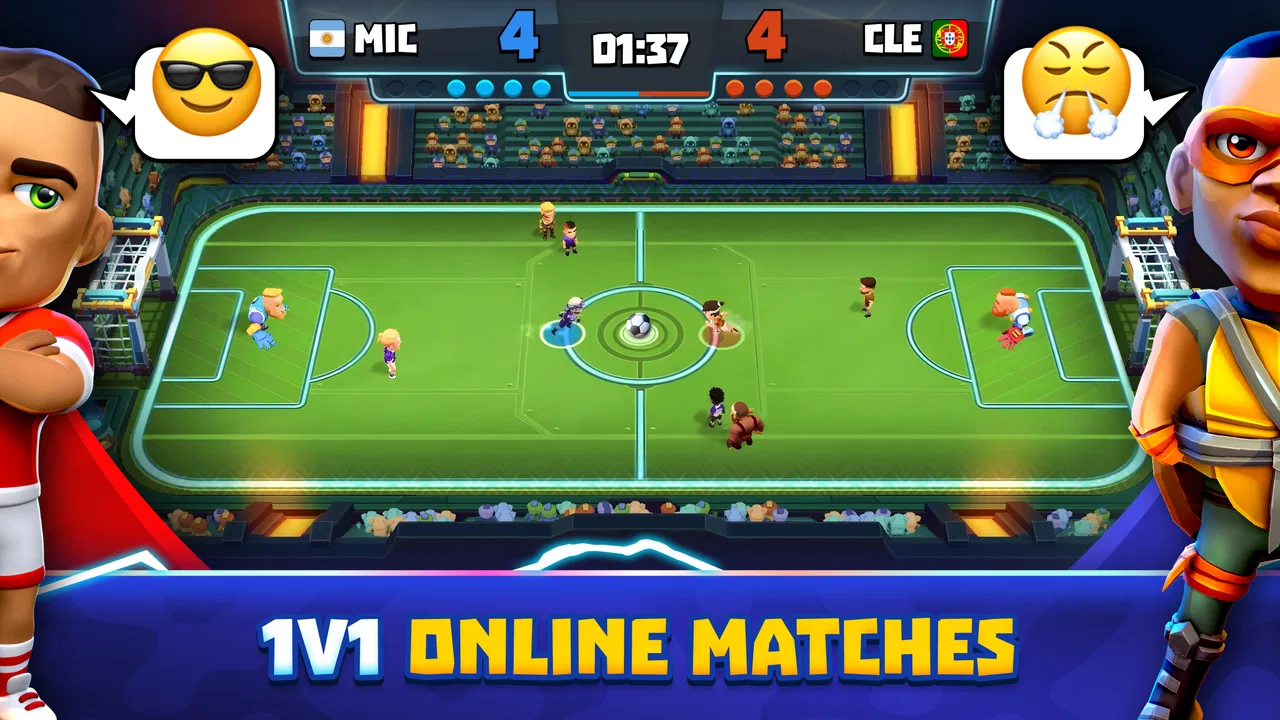
I went into Goal Battle - PvP Soccer Game expecting a quick football game built around scoring before the other player, and that is exactly where its appeal begins. It is a free sports game from MAGE Games that focuses on online matches against real opponents rather than a long single-player campaign. That choice gives every match a little tension: even a short session feels like a contest against someone making decisions on the other side.
What I like most is how quickly the game communicates its purpose. You are not asked to learn a large football simulation before enjoying it. The central pleasure is immediate scoring, reacting, and trying to turn a small advantage into a win. At the same time, the online format means the game is not simply about repeating the same predictable match against computer-controlled opposition. The human element gives the goals more meaning, but it also creates the main weakness: your experience depends partly on the quality and connection of the opponent you meet.
Why the first goals matter so much
The early part of the experience is shaped by the satisfaction of getting on the scoreboard. In a traditional football game, a goal can take several minutes of buildup, and that is rewarding when you want a full match. Here, the attraction is different. Goal Battle is better suited to the player who wants the emotional spike of a goal without committing to a complete, simulation-heavy football session.
You May Also Like

 Google Keep - Notes and lists
Google Keep’s Quiet Growth Shows the Appeal of Simpler Notes
As mobile work gets busier, Google Keep keeps winning a simple contest: capture a thought quickly, find it later, and get on with the day.

 Blood Strike: 2.5 Anniversary
Blood Strike’s Loadouts Turn Every Drop Into a Tactical Gamble
A close look at Blood Strike’s custom loadouts: how fast access to signature weapons reshapes its battle royale rhythm, rewards preparation, and narrows the gap between fights.

 Pandora - Music & Podcasts
Pandora’s Music Is Easy to Start, but Harder to Recover
Pandora’s strength is its low-effort path from a seed to a station. Its weak spot is how much confidence it asks you to place in connection, setup, and quiet recovery.

 8 Ball Pool
 Is Built on Rivalries, Rematches, and Routine
A close look at the rivalries, rematches, shared routines, and unanswered safety questions that turn a quick pool match into a persistent mobile community.

 Samsung Music
’s Quiet Strength Is Playing What You Already Own
Its reach comes less from spectacle than from dependable access to a personal library. That simplicity is both the app’s strongest retention engine and its ceiling.

 AccuWeather: Weather Radar
AccuWeather Review: A Quick, Clear Forecast for Everyday Decisions
For everyday plans, the best forecast is the one you can understand quickly. AccuWeather makes rain timing, radar, and local conditions easy to act on, with a few trade-offs.
More From Our News Desk



I found that the first few matches work best when treated as practice in reading the game rather than as a test of football knowledge. The important habit is to notice how quickly the match changes after a goal. A lead is useful, but it does not make the result feel safe. That keeps the opening minutes active and prevents the first successful attack from deciding everything automatically.
This also makes the game approachable for people who enjoy football but do not want to manage every detail found in larger console-style titles. There is less mental overhead than in a full simulation, so I could play when I had only a short break. A quick round fits naturally after a commute, during a waiting period, or before switching to another app. The trade-off is that anyone looking for deep team management, a complete league structure, or the slow rhythm of a realistic match may find the focused design too narrow.
The online-versus-real-opponents format changes how I value each goal. Against a predictable computer, I tend to repeat whatever works. Against another person, I have to consider whether my opponent has recognized that pattern. A successful move can be useful once and much less effective later. That simple change gives the scoring loop more life than the store summary alone suggests.
My practical advice is to avoid judging the game by a single early loss. The first matches are partly about learning the pace and partly about understanding how aggressive you want to be. Chasing a goal constantly can create openings, while playing too cautiously can waste the short opportunities that make the game exciting. The best early progress came when I focused on making one sensible decision at a time instead of trying to force a spectacular result.
Short sessions with real competitive pressure
The compact match structure is a strong fit for casual players, but it does not make the game completely relaxed. Playing against a real person means a short session can still demand concentration. I could start a round casually and then find myself paying close attention because the score was close. That is a good quality for a mobile sports game: it respects limited time without removing the reason to care.
There is also a useful difference between playing for entertainment and playing to improve. If I only wanted a few minutes of football-themed action, the immediate goals were enough. If I wanted consistent wins, I had to become more patient and observe what was happening instead of attacking automatically. The game therefore has two layers: an accessible scoring loop for newcomers and a more demanding competitive habit for players who stay with it.
How progress feels after the first sessions
Progress in a game like this is not only about a visible reward. It is also about becoming more comfortable with the timing and pressure of online play. I noticed progress when I stopped treating every attack as an emergency. That change made my decisions cleaner and helped me recognize when a goal was worth pursuing immediately and when it was better to protect the situation.
The strongest progress signal is the match itself. A close result tells me more than an easy win because it exposes which decisions are reliable and which ones depend on luck or an opponent’s mistake. When I replayed after a narrow defeat, I had a clear reason to try again: I wanted to handle the same kind of pressure better. That is a healthier loop than simply chasing an arbitrary number on a screen.
Players who need a large collection of unlockable content to feel that they are advancing should approach with more caution. The appeal here is tied closely to competition and repeated improvement. If the main motivation is collecting a huge roster, building a detailed club, or completing a long narrative, a conventional football manager or broader sports title may offer a more satisfying structure.
For me, the most useful way to measure progress was to create small personal targets. Instead of saying I needed to win every match, I focused on avoiding rushed attacks, responding calmly after conceding, or keeping my attention until the final moment. Those goals made the game feel less frustrating when the opponent was stronger. They also gave ordinary matches value even when the result was not in my favor.
That approach matters because online games can make progress feel inconsistent. A player may improve while still losing to someone more experienced. If the only acceptable outcome is victory, the experience can become tiring quickly. Goal Battle works better when I treat wins as confirmation and losses as information. That mindset is not a feature of the app, but it is the best way I found to get more from its focused design.
Who will enjoy the progression most
I would recommend it to football fans who like direct competition, quick goals, and the unpredictability of playing against another person. It is also a reasonable choice for someone who wants a lightweight sports game rather than a large installation built around many modes. The fact that it is free makes trying it straightforward, although the presence of optional purchases means I would still pay attention to spending habits, especially on a device shared with younger players.
The age rating is Everyone 10+, which places it in a space that can suit older children, teenagers, and adults while still calling for sensible supervision around purchases. It is not a reason to avoid the game, but it is worth remembering that competitive design can encourage “one more match” behavior. I would set a personal stopping point before beginning a session, particularly when a close loss makes a rematch feel irresistible.
Difficulty: where the game becomes demanding
The difficulty does not come from controlling an enormous number of football systems. It comes from the opponent. A human player can change approach, punish impatience, and make a match feel different from the one before it. That is the source of the game’s replay value, but it is also why the experience can feel uneven. Some rounds may seem comfortable, while others immediately expose a gap in decision-making.
I prefer this kind of difficulty to a fixed ladder that simply increases numbers, because it makes improvement feel personal. Still, it can be less predictable than a carefully designed single-player campaign. If I want a calm experience where the challenge rises in a clearly measured way, a traditional offline football game may be a better fit. Goal Battle is at its best when I am willing to accept that the next opponent may require a different response.
One non-obvious lesson is that the game rewards emotional control as much as quick reactions. Conceding early can make a player attack recklessly, and that reaction often creates more problems. I had better results when I treated the next play as a fresh decision instead of trying to recover everything immediately. This is especially important in a goal-focused game, where the scoreboard can make every moment feel urgent.
Another useful habit is to separate unfamiliarity from genuine difficulty. A new opponent’s style may seem overwhelming simply because I have not yet identified its pattern. Before changing everything about my own approach, I try to observe whether the same action is repeatedly creating trouble. That small pause prevents me from overcorrecting and makes the competitive loop more thoughtful than a basic exchange of attacks.
The challenge also affects who should skip the game. Players who dislike online competition, unexpected defeats, or matches that depend on another person’s behavior may become frustrated. The game is not the right choice if you want complete control over the pace and outcome. In that case, an offline sports title with adjustable difficulty will probably be more comfortable and more predictable.
What the free model means in practice
Goal Battle is free to play, with optional in-app purchases ranging from small amounts to substantially larger individual items. I see that as a reason to approach the game with a clear boundary rather than as an automatic problem. A free entry point is useful for testing whether the online matches suit you, but competitive repetition can make optional spending feel tempting when you want progress to feel faster.
My recommendation is simple: play enough to decide whether the core matches are enjoyable on their own. If the answer is yes, the game has already done its job without requiring a purchase. If the answer is no, buying something is unlikely to fix the underlying mismatch. This is one of the most important distinctions between paying for convenience and paying because the basic gameplay is not holding your attention.
I would also avoid making a purchase immediately after a frustrating loss. That is when the desire to recover momentum is strongest, and it is not the best moment for a calm decision. The game’s competitive pressure is part of its appeal, but it can also encourage impulsive choices. Treating purchases as optional extras rather than solutions to a bad session keeps the experience healthier.
Does the pacing keep me coming back?
The pacing is built around a repeating question: can I score before the other player changes the situation? That question is strong enough to support repeated sessions, especially when matches remain short and close. I often wanted another attempt not because I had unlocked something dramatic, but because I felt I had made one poor decision and could handle it better next time.
That is a meaningful retention loop, but it has limits. Repetition works when each match feels like a fresh contest. It becomes less effective if the player starts seeing the same situations without learning anything new. The online format helps by introducing different human choices, yet it also means the sense of variety depends on the opponents available and on how well their styles differ.
The game’s retention pressure is therefore competitive rather than story-driven. There is no need to invent a larger narrative around it: the reason to return is the next contest, the chance to improve, and the satisfaction of turning a close situation around. Players who enjoy ranked-style tension or personal mastery may find that compelling. Players who need constant new environments, characters, or missions may eventually want a broader game alongside it.
One practical use case is playing it as a warm-up before a longer sports game. A few focused rounds can sharpen attention without requiring the commitment of a full simulation. I also think it works well for friends who want to compare results informally, although the central appeal remains the direct online matchup rather than a deep social system. The game gives you a reason to concentrate, but it does not need to become your only football game.
The current version is 4.705.1, and the game requires Android 9 or later. That makes the device requirement relevant for older phones and tablets. On a compatible device, I would still prefer a stable connection and enough battery for online play, because a competitive match is less enjoyable when the phone is struggling or the network is unreliable. Those are ordinary mobile considerations, but they matter more here than in an offline football game.
How it compares with familiar football alternatives
Compared with a full football simulation, Goal Battle is easier to start and less demanding in terms of management. You are not choosing it for a complete season, detailed tactics, or the feeling of controlling every phase of a realistic match. You are choosing it for concentrated goal-focused competition. That makes it more convenient for short sessions, while the larger simulation remains better for players who want depth and long-term club involvement.
Compared with an offline arcade football game, the real-opponent format gives this title more unpredictability. An offline alternative can be better when you have no dependable connection or when you want to practice without pressure. Goal Battle wins when the human response is the main attraction. The difference is not simply online versus offline; it is whether you want the opponent to surprise you.
Compared with a football manager, this is almost the opposite kind of experience. A manager game rewards planning, transfers, statistics, and patience. Goal Battle rewards immediate decisions and the ability to stay composed during a contest. I would not replace one with the other. They serve different moods, and this game is the better choice when I want to play football rather than organize it.
My progression verdict
After spending time with it, I see Goal Battle as a focused sports game whose strongest progression comes from improving how I play, not from pretending that every session needs a huge amount of new content. The early goals are satisfying because they arrive quickly, the online opponents keep the challenge from becoming completely predictable, and the pacing makes short sessions easy to fit into everyday life.
Its limitations are equally clear. The experience can feel stressful for players who dislike human competition, and the free-to-play structure calls for self-control around optional purchases. It also will not satisfy someone searching for a complete football simulation, a management career, or a rich offline campaign. Those are not small omissions; they define what this game is and what it is not.
The rating of 4.6 from around seventy-six thousand ratings and more than five million installs suggest that the focused idea has found a substantial audience. I would not treat popularity as proof that everyone will enjoy it, but it does match my impression that the core loop is easy to understand and hard to dismiss once a close match begins.
My final recommendation is to try it if you want free, direct football competition and are comfortable with the unpredictability of real opponents. Give yourself several matches to learn the pace, judge the game by the quality of the contests rather than by one defeat, and decide in advance whether you are willing to ignore optional spending. The best reason to keep playing is the feeling that your next goal came from a better decision, not from simply repeating the last match.
For me, that makes Goal Battle a good companion to, rather than a replacement for, a larger football game. It delivers a compact competitive fix, asks for attention without burying the player in systems, and leaves enough room for personal improvement to matter. If that balance sounds appealing, MAGE Games’ title is worth a try on a compatible Android device.
FAQs for Goal Battle - PvP Soccer Game
01What is the main objective of Goal Battle - PvP Soccer Game?
Goal Battle - PvP Soccer Game is designed to provide an intense and competitive soccer experience where players face off against each other in real-time matches. The main objective is to score more goals than your opponent within the time limit, utilizing strategic gameplay and skillful maneuvers to outplay your rivals.
02Can I play Goal Battle - PvP Soccer Game offline?
No, Goal Battle - PvP Soccer Game requires an internet connection to function properly. As it is primarily a player-versus-player game, players need to be connected to the internet to match up with opponents in real-time. This also ensures that players have access to the latest updates and features.
03What are the in-app purchases available in Goal Battle - PvP Soccer Game?
Goal Battle offers various in-app purchases that enhance the gaming experience. Players can buy cosmetic items to customize their avatars, access premium features, or purchase power-ups that provide a competitive edge during matches. While these purchases can enhance gameplay, they are optional and not required to enjoy the game.
04Is Goal Battle - PvP Soccer Game suitable for children?
Goal Battle is suitable for players of all ages, but parental guidance is recommended for younger children due to the competitive nature of the game and the potential for in-app purchases. The game encourages strategic thinking and quick decision-making, which can be beneficial for developing cognitive skills.
05How can I improve my skills in Goal Battle - PvP Soccer Game?
Improving your skills in Goal Battle involves practice and understanding the game's mechanics. Players should focus on honing their timing and precision for shooting and defending. Watching replays of matches can also provide insights into opponents' strategies. Additionally, joining community forums can offer tips and advice from experienced players.
Pros
- Exciting real-time PvP matches.
- Smooth and responsive controls.
- Vibrant graphics and animations.
- Various game modes available.
- Customizable player avatars.
Cons
- Requires constant internet connection.
- Limited offline gameplay options.
- In-app purchases can be costly.
- Some ads disrupt gameplay flow.
- Occasional matchmaking delays.

Goal Battle - PvP Soccer Game
Gallery